
Effective Strategies for Maintaining a Cooler Home During the Summer Without Constantly Running the Air Conditioner
Maintaining a comfortable indoor environment during the summer can be a difficult task as the temperature outside increases.
While it may appear to be the most straightforward solution, operating the air conditioner continuously throughout the day can result in an increase in energy consumption and an increase in your monthly electricity bill.
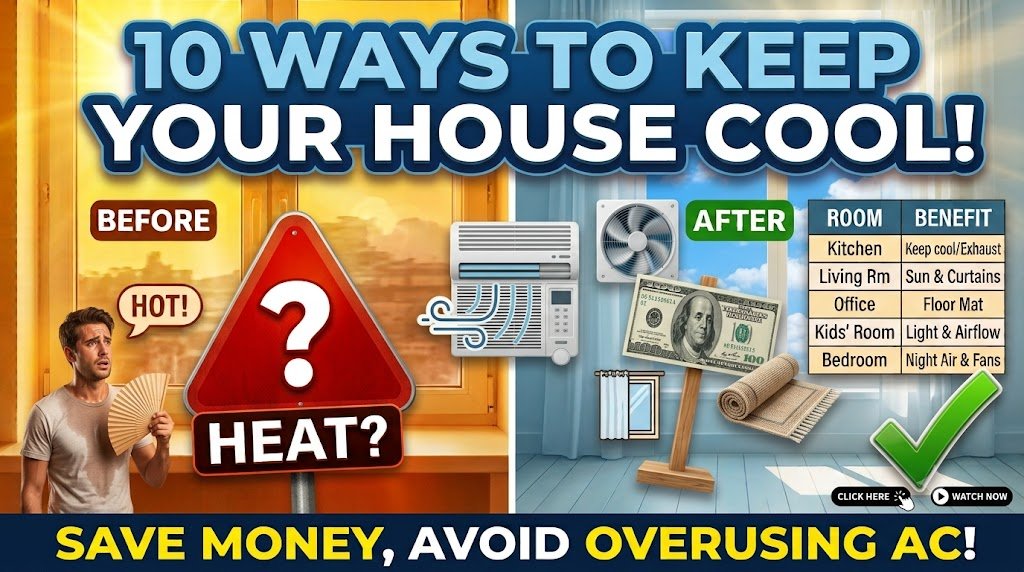
Fortunately, there are numerous straightforward methods to maintain a comfortable temperature in your home during the summer months without relying solely on your air conditioning unit.
During hot weather, your home can be more comfortable by making minor adjustments to the way you manage sunlight, airflow, windows, fans, and household appliances.
1. Prevent Direct Sunlight
The temperature inside your home can be rapidly elevated by the sunlight that enters through your windows.
Pay close attention to windows that are exposed to intense afternoon sunlight.
To mitigate the direct heat that enters the room during the hottest hours of the day, close your curtains, blinds, or shades.
You do not necessarily require costly window treatments.
Even the most basic curtains or blinds can be used to obstruct a portion of the sunlight and prevent rooms from becoming excessively warm.
2. Timing the Opening of Windows
It is not always advisable to open all windows during the summer.
Open windows can actually transfer more heat indoors if the outdoor air is hotter than the air inside your home.
Alternatively, consider opening the windows during cooler periods, such as the evening or early morning, when the ambient temperature decreases.
This can assist in the replacement of warm indoor air with colder outdoor air.
To maintain the cooler air within, seal the windows once the outdoor temperature resumes to increase.
3. Utilise fans to enhance airflow.
By circulating air across your body, fans can enhance the comfort of a space.
A ceiling fan can assist in the circulation of air throughout a room, while portable fans may be advantageous in particular regions.
It is important to note that fans cool individuals rather than reducing the temperature of a room in the same manner as an air conditioner.
Consequently, it is advisable to deactivate the ventilation when the room is not in use.
Continuously operating a fan in an unoccupied area yields minimal advantages.
4. Properly Operate Your Ceiling Fan
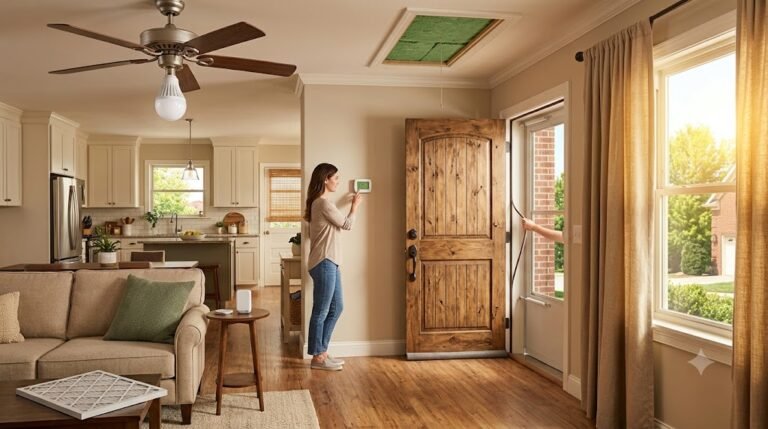
Verify that the directional switch on your ceiling fan is configured for summer use.
In numerous instances, the fan’s preferred summer setting enables it to circulate air downward, thereby generating a refreshing airflow.
The fan speed can be adjusted to suit the comfort level of the room.
Additionally, employing a fan in conjunction with your air conditioning unit can enable you to achieve a level of comfort that is slightly higher than the standard thermostat setting.
5. Ensure that your windows are covered during the hottest hours.
In sweltering weather, window coverings can have a significant impact.
The accumulation of heat in a room can result in discomfort if sunlight is allowed to penetrate for an extended period.
Before the most intense sunlight illuminates the room, draw the blinds and curtains.
Pay close attention to windows that are exposed to the afternoon sun.
When temperatures begin to decrease, or sunlight becomes less intense, the coverings may be retracted.
6. Refrain from operating the oven during the hottest part of the day.
Your oven has the capacity to produce an unexpected amount of heat within your residence.
Prepare meals earlier in the day or later in the evening during exceptionally humid weather.
Additionally, meals that necessitate minimal cooking can be selected when feasible.
When suitable, the quantity of heat that is released into your kitchen can be diminished by employing a countertop appliance, outdoor cooking option, or microwave.
Adding less heat to an indoor environment can facilitate the maintenance of a comfortable environment.
7. Utilise your exhaust fans.
The removal of warm, humid air from your home can be facilitated by the exhaust fans in your kitchen and bathroom.
Utilise the kitchen exhaust fan when cooking, particularly when boiling water or preparing meals that generate steam.
Additionally, bathroom exhaust blowers can assist in the removal of humid air following showers.
During hot weather, the removal of excess moisture can enhance the comfort of interior environments.
8. Inspect Your Windows and Doors for Air Leaks
The degree to which your residence maintains an agreeable indoor temperature can be influenced by minor gaps around windows and doors.
Check for any apparent gaps or openings that allow outdoor air to enter.
Pay particular attention to older windows and exterior entrances.
Sometimes, weatherstripping and caulk can be employed to seal the necessary gaps.
Nevertheless, it is crucial to select materials that are appropriate for the specific surface and location.
9. Maintain the Cleanliness of Your HVAC Filter
Despite your efforts to decrease the frequency of AC operation, it is imperative that the system functions effectively when required.
The airflow can be restricted by a filthy or clogged HVAC filter.
In accordance with the manufacturer’s instructions, inspect the filter and replace or clean it as necessary for your system.
Additionally, conducting a straightforward filter inspection can serve as an advantageous component of your standard home maintenance regimen.
10. Close the doors to rooms that are not in use.
It may be unnecessary to maintain the temperature of all areas of the house at the same level if certain rooms are infrequently utilised.
Maintain the closure of doors when necessary and concentrate your cooling efforts on the areas that are currently in use.
Nevertheless, refrain from closing doors or blocking necessary HVAC vents if this would disrupt the heating and cooling system’s design.
The objective is to regulate the airflow in your residence without causing any complications for the HVAC system.
11. Deactivate Extraneous Lights
Especially when multiple lights are operating in a confined room, lights can generate heat.
Utilise natural light during the daytime when it does not generate excessive heat.
Turn off any lights that are not required at night.
It is also possible to decrease the amount of heat produced by lighting and the amount of electricity consumed by replacing frequently used incandescent bulbs with LEDs if you continue to use older lighting.
12. Disconnect any electronic devices that are no longer required.
While in operation, numerous household electronics produce heat.
When utilised for extended periods, chargers, gaming systems, computers, televisions, and other devices can contribute to interior heat.
Unnecessary electronics should be deactivated on exceptionally hot days.
Pay close attention to devices that operate continuously for extended periods of time without being utilised.
In rooms that are already warm, the reduction of superfluous electronic heat can make a small difference.
13. Maintain a Cool Bedroom at Night
Summer nights can be uncomfortable when the bedroom is excessively hot.
When feasible, prevent sunlight from entering the chamber during the day.
If the outdoor temperature is lower in the evening, open the windows and utilise a fan to enhance airflow.
In hot weather, opt for breathable sleepwear and lightweight linens.
It is also possible to prevent the accumulation of additional heat in the room by turning off superfluous electronics.
14. Pay Close Attention to Humidity
The level of comfort in your residence is not solely determined by temperature.
High levels of indoor humidity can exacerbate the discomfort associated with high temperatures.
Utilise lavatory and kitchen exhaust fans when necessary to eliminate moisture.
During the hottest part of the day, refrain from engaging in activities that contribute significant amounts of moisture to the indoor air.
If the humidity levels in your residence are consistently elevated, it may be more advantageous to pinpoint the source rather than attempting to chill the air.
15. Establish a Basic Summer Cooling Routine
It is unnecessary to modify every aspect of your residence in order to enhance your comfort during the summer.
Alternatively, establish a straightforward daily regimen.
Utilise the cooler outdoor air when feasible in the morning.
Block direct sunlight and close windows as temperatures increase.
Avoid generating excessive heat from electronics, lights, and cookery during the hottest hours.
If the temperature outside is lower in the evening, reopen the windows.
Consistently adhering to this regimen can mitigate the accumulation of heat within your residence.
In summary,
It is not necessary to operate your air conditioning system continuously throughout the summer in order to maintain a comfortable indoor environment.
Closing curtains during the hottest hours, opening windows when outdoor temperatures are lower, using ventilation, reducing indoor heat, and managing humidity are all simple habits that can be beneficial.
It is also important to inspect your HVAC filter, windows, doors, and airflow to ensure that your cooling system is functioning correctly when you require it.
There is no single method that will ensure that every residence remains cool for the duration of an entire summer, particularly during periods of extreme heat.
Nevertheless, the cumulative effect of a number of minor modifications can result in a substantial improvement in the ambience of your residence.
The most effective method is to begin with the most straightforward modifications and determine which ones are most suitable for your specific residence.