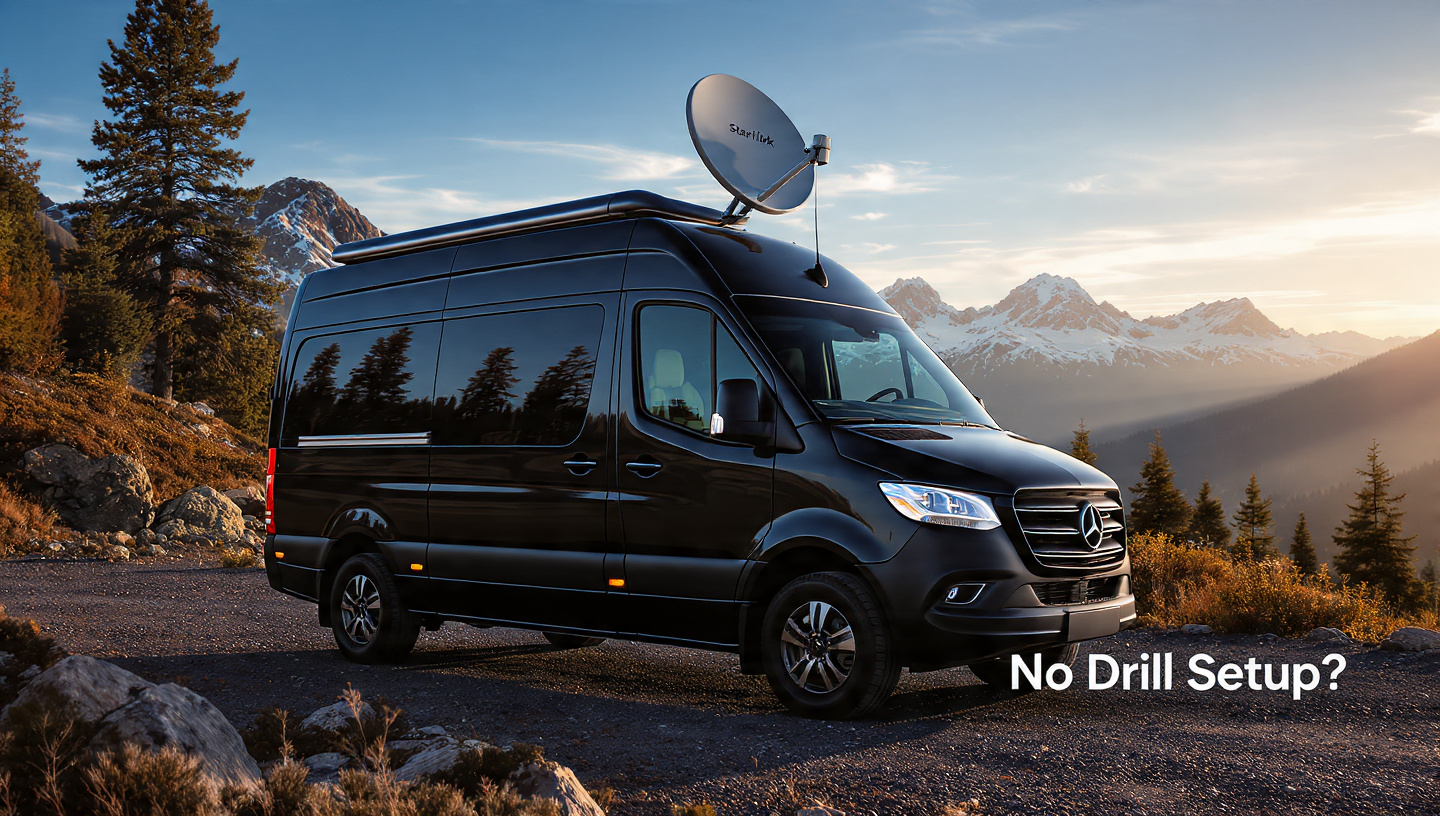
How to Install Starlink on the Roof of a Sprinter Van Without Drilling
It’s inevitable that you’ll feel a shudder go down your spine the moment you lay eyes on your $80,000 Sprinter vehicle and hold your Starlink dish. You desire high-speed internet, but the idea of damaging your immaculate roof with a power drill gives you the willies.

For some that identify as van-life, “No-Drill” is more than a personal preference; it’s a sacred practice. Finding a sturdy starlink roof mount without causing permanent damage is the ultimate goal, whether you’re concerned about future corrosion, possible leaks, or simply wanting to keep your rig’s resale value.
In this detailed tutorial, we will show you how to secure your dish like a pro. Here are a few ways to stay connected while traveling at 70 MPH without using a drill: stealthy magnetic setups and the standard starlink roof rack mount.
1. Reason Nomads Will Not Speak Anything Less Than “No-Drill”
The starlink roof mounting kit is typically used for fixed-house installations in traditional home setups. The task of fastening a tripod to a shingle roof is expected of you. Putting that on a van is asking for trouble. In time, the bolts will become loose due to road vibration, and rain will seep into your insulation, causing mold that you won’t notice until it’s too late.
On top of that, a lot of us are always investing in better tools. The “Starlink Gen 5” that may be available in the future may not be compatible with the permanent starlink roof mount kit that you install today. You can adapt your rig to new technology with modular, no-drill options.
2. The Most Effective “Legal” Method: The Roof Rack Strategy
You may consider yourself halfway there if your Sprinter has side rails or a full rack, like a Flatline or RoamBuilt. Many individuals regard a starlink roof rack mount as the “Gold Standard” when it comes to serious travelers.
You can secure a mounting plate to your rack using the pre-existing T-slots, avoiding direct contact with the van’s metal surface. Those who park under dense trees will find the pole mount roof rack for starlink to be an absolute godsend. In a matter of seconds, you may raise your dish above the canopy line by sliding a 10-foot pole into a fixed bracket on your rack.
When it comes to aerodynamics and “stealth,” nothing beats a horizontal starlink roof rack mount. It maintains the dish low-profile and practically undetectable from the ground.
3. Installing the Starlink Mini: A Compact Dish with Huge Impact
Van life’s aerodynamics have been revolutionized by the new Mini. The Gen 3 requires heavy-duty industrial hardware, which is unnecessary for a starlink mini roof mount due to its smaller and lighter design.
One particular configuration for the Mini is experiencing a meteoric rise in popularity: the starlink mini roof rack mount. There is just one thin DC cord to keep track of on the Mini because it has an integrated router. Because of its diminutive size, the dish won’t obstruct your solar panels or MaxxAir fans, and it can be tucked into a corner of your rack.
Do not fret if you are lacking a rack. We will also go over how to use magnetic feet or heavy-duty vacuum cups to modify the starlink mini roof mount.

4. Getting a Grip on the Hardware: Kits vs. Do It Yourself
Many of the generic alternatives sold as starlink roof mounting kit options will catch your eye when you begin your search. Watch out. Lots of these are really merely 2005 satellite TV mounts that have been recycled.
The following components are essential for any current, high-quality car starlink roof mount kit:
-
UV-resistant spacers: Avoid vibrations caused by metals touching.
-
Locking knobs: When you enter a “sketchy” location where theft is a concern, locking knobs allow you to remove the dish swiftly.
-
Clips for managing cables: Since the most common reason hardware fails is a dangling cable flapping at 80 miles per hour.
A starlink roof mounts setup with a “quick-release” feature is your best bet for adaptability. If you’re parked in a shaded place, you can retain the base on the van and use a tripod to take the dish from 50 feet away.
5. Leading Three Ways to Mount Without Drilling in 2026

A. The Magnetic Array (The Champion of Speed)
Our “80 MPH Safety” manual raves about the excellent starlink roof mounts that use N52 Neodymium magnets. They offer a pulling force of hundreds of pounds. This is the best possible “No-Drill” installation for a Sprinter vehicle that has a steel roof. Make sure the magnets are covered with rubber to prevent damage to your paint.
B. The VHB Mounting Adhesive
Whenever magnets aren’t an option, such as on an aluminum roof or a fiberglass high-top, 3M VHB tape is a lifesaver. Expert solar installers utilize VHB to securely fasten 30-pound panels to the tops of vans without using any screws. Despite being technically removable with the help of a heat gun and dental floss, the unique starlink roof mounting kit plate that is fastened by VHB is surprisingly persistent.
C. The Roof Rack Adapter with a T-Slot
The starlink roof rack mount provides the highest level of security for individuals who own a rack. To attach the rack to the rails, you’ll need stainless steel T-nuts. Sturdy as a rock, it gives the impression of being “factory-installed,” and you can adjust its position on the van to accommodate your solar panels.
6. Managing the “Aero-Drag”
Wind noise is something that the majority of starlink roof mounting kit installations fail to address. Simply put, a Starlink dish is a flat surface. Both the drag and the “whistling” sound it produces are noticeable at 75 MPH.
The Fix: To avoid any potential interference, position your starlink mini roof rack mount attachment behind a wind deflector or front light bar. This deflects the wind away from the dish, which improves gas efficiency (yep, a dish may actually reduce your MPG by 1-2 points!) and eases the strain on your starlink roof mounting kit.
7. The One Thing We Think Sprinter Owners Should Do
🛠️ Editor’s Choice: [The All-Terrain Starlink Roof Rack Adapter]
This is made to fit Sprinter side rails only. A starlink roof rack mount and a quick-release mechanism are both included. Installs in only 5 minutes with no drilling and no rust. [Check Price on Amazon] (Affiliate Link)
8. The Last Word: Which Mount Is Right for You?
-
A specialized starlink roof rack mount is the way to go if you own a roof rack. It looks the most professional and is the safest choice.
-
For the most “set it and forget it” convenience with your Mini, choose the starlink mini roof mount (magnetic version).
-
Obtain height by purchasing a pole mount roof rack for starlink. In the dense forests of the Pacific Northwest, it is the sole means of receiving a signal.
If you own a van, Rapidove thinks you should be able to keep connected without damaging your property. Forget about “roof anxiety” and ride freely on the open road with a high-quality, no-drill starlink roof mount.
FAQs
Q: Will installing a starlink roof mount kit render my van’s warranty null and void? A: Nah, if you don’t want to bore holes! The advantage of starlink roof mounts that require no drilling is that the vehicle’s construction remains unaltered.
Q: In a car wash, is it okay to leave the dish on top? A: Definitely not. The powerful scrubbing action of an automated vehicle wash will damage even the most sturdy starlink mini roof rack mount attachment. Utilize a quick-release mechanism at all times.
Q: I don’t want to drill any holes, therefore how can I run the cable inside? A: The majority of people who live in vans route the wire through the weather stripping on the back door or into an existing cable gland that holds solar panels.